Treatment
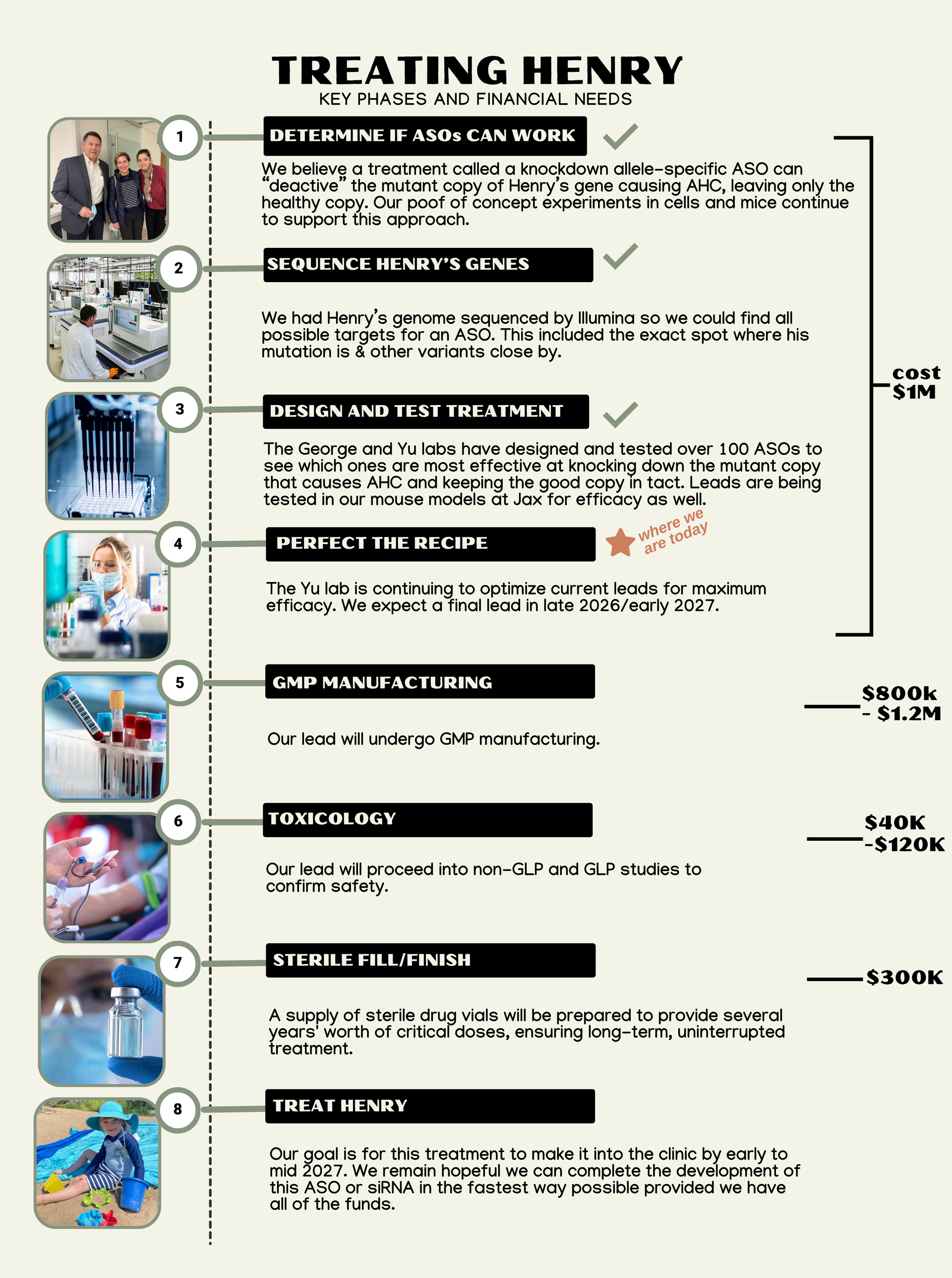
While there has historically been no targeted treatment for AHC, Henry’s parents are developing an RNA-targeted therapy (an ASO or siRNA) for Henry that will be the first disease-modifying treatments for AHC.
We are thrilled to be working with world-renowned Dr. Tim Yu's team at Boston Children's Hospital is leading the development of these RNA-targeted treatments. The Yu team is working in collaboration with the Lutz, van den Maagdenberg, Sweadner, Yano, and George laboratories to establish proof of concept in vitro and in vivo.
These ASO and siRNA treatments could serve as a blueprint for developing therapies for others with AHC, with potential implications for hundreds of other neurological diseases.
Antisense oligonucleotides, or ASOs, are short, synthetic strands of genetic material designed to bind to a specific messenger RNA, or mRNA, and modify gene expression. Depending on the underlying mutation, ASOs can reduce—or “knock down”—the production of a harmful protein or increase the production of a needed protein.
Small interfering RNAs, or siRNAs, are short, double-stranded RNA molecules that harness the cell’s natural machinery to identify and break down a specific mRNA. By destroying the targeted mRNA before it can produce protein, siRNAs can reduce the production of a harmful protein.
We believe an allele-specific knockdown treatment—using either an ASO or siRNA—may be the most promising approach for Henry. This type of treatment is designed to selectively reduce the activity of the disease-causing copy of the gene while preserving the healthy copy. By lowering production of the harmful mutant protein, the treatment could reduce its toxic effects while allowing the healthy gene to continue functioning.
This treatment for Henry and others with AHC is on track to be ready by the early/mid 2027.
In partnership with: